Gliese 581g lies some 20 light-years away in its star's "Goldilocks zone" - a region surface temperatures would allow the presence of liquid water.
Scientists say that the newly found world could also potentially have an atmosphere.
Their findings, made with the Keck telescope in Hawaii, appear in the Astrophysical Journal.
The researchers, from the University of California at Santa Cruz (UCSC) and the Carnegie Institution of Washington, have been studying the movement of the planet's parent star, a red dwarf called Gliese 581, for 11 years.
Their observations have revealed a number of exoplanets spinning around the star.
Possibility of life
Recently they discovered two new alien worlds, so together with the previous findings, this brings the number of planets orbiting Gliese 581 to six.
But the most important new revelation is that one of those worlds might be the most Earth-like planet yet identified.
"Our findings offer a very compelling case for a potentially habitable planet," said Steven Vogt, an astronomer at UCSC.
"The fact that we were able to detect this planet so quickly and so nearby tells us that planets like this must be really common."
Gliese 581g has a mass about three to four times that of Earth. It orbits its sun in 37 days and is thought to be a rocky world. It has enough gravity to possibly have an atmosphere.
 Another Earth-like planet, Gliese 581c, was discovered a few years ago
Gliese 581g is located in its star's "Goldilocks zone" - a zone in space where temperatures are neither too hot nor to cold for liquid water.
Such a zone defines the region in a star-centered orbit where an Earth-like planet could sustain that water on its surface - and therefore life.
"We had planets on both sides of the habitable zone - one too hot and one too cold - and now we have one in the middle that's just right," said Dr Vogt.
The planet's average surface temperature is estimated to be between -12C and -31C.
But unlike Earth, this alien world has one side always facing its sun and the other side constantly in the dark. So in-between the two sides, between shadow and light, there could be an area where life could potentially thrive.
"Any emerging life forms would have a wide range of stable climates to choose from and to evolve around, depending on their longitude," said Dr Vogt.
Alien worlds
The first exoplanet orbiting a star was detected more than a decade ago.
Since then, nearly 500 other worlds have been found beyond our Solar System, many of them Jupiter-like gas giants.
Now, astronomers are hoping to spot more exoplanets where life could be possible.
"We're at exactly that threshold now with finding habitable planets," said Paul Butler of the Carnegie Institution, a co-author of the study.
Dr Vogt agreed: "The number of systems with potentially habitable planets is probably on the order of 10 or 20%, and when you multiply that by the hundreds of billions of stars in the Milky Way, that's a large number," he said.
"There could be tens of billions of these systems in our galaxy."
Any emerging life forms would have a wide range of stable climates to choose from and to evolve around, depending on their longitude”
Steven VogtUniversity of California, Santa Cruz





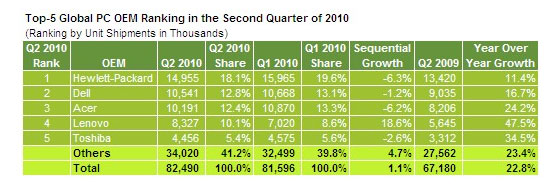 A few companies track PC shipments around the globe including iSuppli. In July, iSuppli offered up the numbers for Q1 2010 and Acer overtook Dell for the second place in the global PC shipment list.